

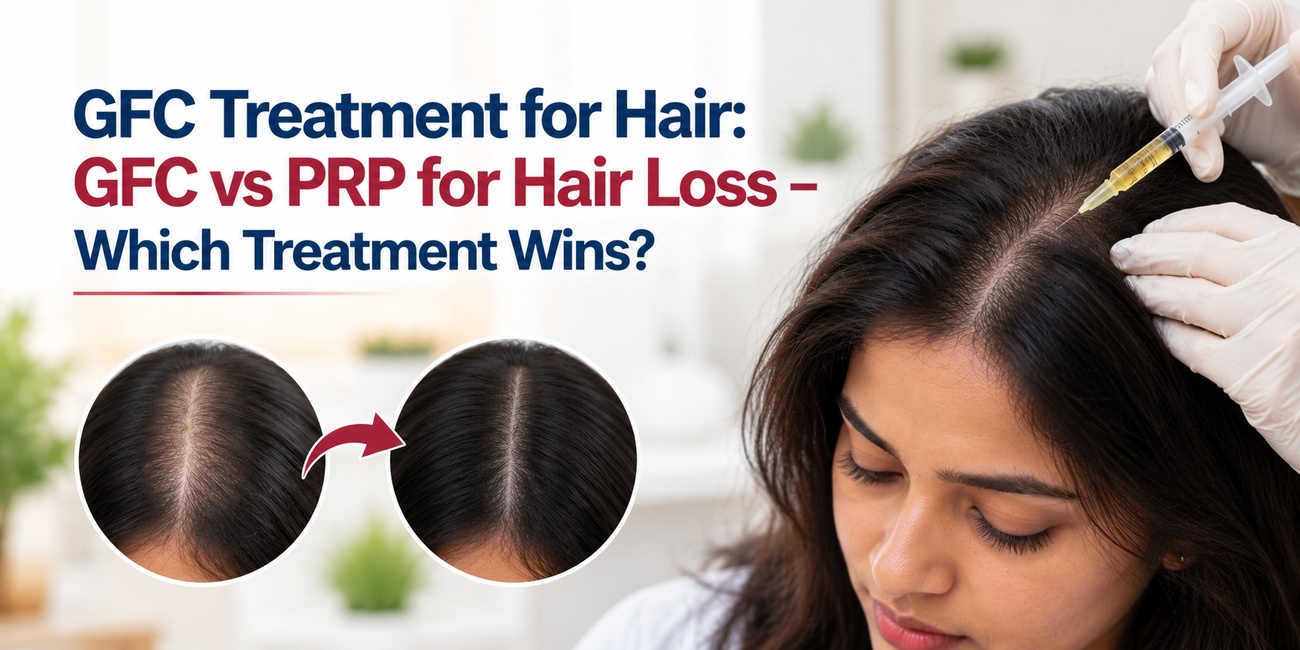
GFC Treatment for Hair: GFC vs PRP for Hair Loss – Which Treatment Wins?
Hair thinning can be frustrating, especially when hair fall continues despite using shampoos, oils, or supplements. Among the newer non-surgical options, GFC treatment for hair and PRP have gained attention for their ability to support weakened hair follicles. But when comparing GFC vs PRP hair loss, which one should you choose?
Both treatments use growth factors derived from your own blood, but the preparation and delivery methods are different. PRP has been studied for years and has shown potential to improve hair density, while GFC is a newer approach designed to deliver a concentrated growth-factor preparation. A 2026 comparative study found that GFC produced better improvements in some measures during treatment, although PRP showed some stronger results at six months.
What Is GFC Treatment for Hair?
GFC stands for Growth Factor Concentrate. In this treatment, a small amount of the patient’s blood is processed to obtain a concentrated preparation containing growth factors. These substances are involved in tissue repair and cellular signalling and may help support weak or miniaturised hair follicles.
Unlike conventional PRP, GFC is prepared using a specialised processing method intended to separate the growth-factor-rich portion from unwanted blood components. The resulting preparation is then injected into areas affected by thinning.
The goal is simple: provide targeted growth signals to follicles that are still active but producing thinner or weaker hair.
How Does PRP Work for Hair Loss?
PRP, or Platelet-Rich Plasma, also uses the patient’s own blood. After collection, the blood is processed to separate platelet-rich plasma, which contains several growth factors.
The prepared PRP is injected into the scalp, particularly in areas where hair density has reduced. These growth factors may support the hair-growth cycle and improve the thickness and density of existing hair.
Research supports PRP as a potentially useful option for androgenetic alopecia, although studies differ considerably in their preparation methods, treatment schedules and outcomes. A 2024 meta-analysis found an increase in hair density with PRP but rated the overall evidence as low quality because of substantial study variation.
GFC vs PRP Hair Loss: Key Differences
Factor | GFC | PRP |
Full form | Growth Factor Concentrate | Platelet-Rich Plasma |
Source | Patient’s own blood | Patient’s own blood |
Main focus | Concentrated growth factors | Platelet-rich plasma and growth factors |
Treatment type | Scalp injections | Scalp injections |
Evidence | Newer and still developing | More extensively studied |
Suitable for | Selected types of hair thinning | Commonly used for pattern hair loss |
Results | Vary by patient and condition | Vary by patient and treatment protocol |
This hair loss treatment comparison shows why there is no universal winner. The right option depends on the cause and severity of hair loss, follicle condition, age, medical history and previous treatments.
Which Is Better: GFC or PRP?
If the question is GFC vs PRP hair loss, GFC may appear attractive because it is designed around a concentrated growth-factor preparation. However, newer does not automatically mean better for every patient.
A 2026 retrospective comparative study involving male and female pattern hair loss reported better total hair count, shaft diameter and aesthetic improvement scores with GFC during treatment. However, at six months, PRP showed better results for hair diameter and aesthetic improvement, suggesting that longer-term outcomes may not always favour GFC.
PRP, meanwhile, has a larger body of published research. Multiple systematic reviews have reported improvements in hair density, although researchers also highlight limitations such as inconsistent protocols and study quality.
Therefore, the best treatment for hair regrowth should not be selected only by comparing the names of the procedures. A dermatologist should first identify why the hair is falling.
How Many GFC Sessions Are Needed?
There is no fixed number of sessions that works for everyone. Treatment plans may vary depending on the degree of thinning, the underlying cause and how the scalp responds.
Many clinics plan an initial series of multiple sessions spaced several weeks apart, followed by maintenance when required. Your dermatologist can recommend the appropriate schedule after examining your scalp and hair-growth pattern.
It is also important to have realistic expectations. GFC and PRP are generally intended to support existing, weakened follicles; they cannot be expected to restore hair from follicles that are no longer viable.
Is GFC Safe for Long-Term Use?
Because GFC is prepared from the patient’s own blood, it is generally considered a minimally invasive treatment. However, injections can cause temporary discomfort, redness, swelling or tenderness.
Long-term safety and effectiveness data for GFC are less extensive than those available for PRP. Therefore, treatment should be performed by a qualified medical professional after proper evaluation rather than chosen solely because it is marketed as a newer procedure.
GFC or PRP: What Should You Choose?
There is no single answer to GFC vs PRP hair loss. PRP has stronger historical research support, while GFC is an emerging treatment with encouraging comparative findings but a smaller evidence base.
If you are experiencing persistent thinning or excessive hair fall, professional diagnosis should come first. At Sarin Wellness, hair concerns can be evaluated to help determine whether GFC, PRP or another approach is more appropriate for your individual needs.
Looking for a personalised approach to hair restoration? Consult Sarin Wellness to understand your hair loss and explore suitable options for healthier-looking, stronger hair.
Frequently Asked Questions
What is GFC treatment and how is it different from PRP?
GFC, or Growth Factor Concentrate, uses a processed preparation containing concentrated growth factors from the patient’s blood. PRP uses platelet-rich plasma containing platelets and growth factors. Their preparation methods and composition differ, although both are injected into the scalp.
Which is more effective for hair regrowth, GFC or PRP?
Neither can be called universally superior. Recent research has shown promising results with GFC, while PRP has a larger research base. The better option depends on the type and stage of hair loss and the condition of the hair follicles.
How many GFC sessions are needed for hair loss?
The number varies according to individual hair loss and treatment response. A dermatologist may recommend a series of sessions separated by several weeks, followed by maintenance treatment when appropriate.
Is GFC treatment safe for long-term use?
GFC is minimally invasive and uses the patient’s own blood, but long-term evidence is still developing. Temporary redness, tenderness or swelling can occur after injections. A qualified dermatologist should assess suitability before treatment.